Monday, 30 April 2012

WATER SKIING


The inventor of water skiing is undoubtedly the Minnesota, Ralph Samuelson.  In 1922, a teenager at that time, changed his snow skis to be used on the surface of the lake. He is a recognized inventor of water-skiing.
It is estimated that 20,000 people water-ski for fun. Of course, it didn't take long and competitions were held. The world championship is held in several categories. From the humble beginning it developed now into a sophisticated sport and equipment industry. Skies are made of fibreglass and the binding is made of rubber which supports the ankle but releases the foot the moment the skier falls.
There are different skis for each discipline.
In a tournament of water skiing are three different events. It includes slalom, jumping and trick skiing. The skier wins points in every event and at the end there is one champion. The skiers in slalom have one ski, the competitors in jumping use two skies. The trick skier uses either one or two skies.


SLALOM

Slalom
The slalom is held on a 259m long course. The boat drives down straight but the skier rides from side to side going round the outside of the six buoys. The skiers continue until they fall or miss a buoy. After every buoy the difficulty increases because the boat either speeds up or the towline shortens. The winner is either of rounding the highest number of buoys or on a shortened line the most buoys

Ski Jumpers
Ski jumpers have short lines but face the fibreglass ramp. The ramp is waxed and has running water on it. For men it is 1.65-1.8m and for women 1.5m high. The boats have to pass on the right of the ramp and the skiers go to the left, racing up the slop and shooting into the air. They allowed three jumps and on record is the longest jump.

Trick Skiing
Trick skiing is on a straight 175m long course. The skier does as many tricks as possible in a 20 second pass. There are a set of points for every trick. Some tricks are only basic like turning and skiing backward. The high scoring points is a back flip. Another is leaping over the towline. Toe-holds are where the skier grips the handle with the feet. All these tricks are supervised by five judges to make sure it is done correctly.

Ski Racers
Ski racers are done with one long ski and the skier can lean back into supporting straps. In a competitor race, there can be up to 60 boats and the speed can reach 130km/h. The crew consist of two. One is the driver and the other the observer who is watching over the skier.

Freestyle
Freestyles are skiers who jump off the ramp and do daring tricks. The tricks are helicopters spins and twisting flips. They are judged on style and distance which can be up to 40m and they get points on that. This distance is incredible even without a stunt.

Barefoot
Barefoot water skiing is a serious and earnest business. They still get the old joke to hear - Hey, you've forgotten your skis. In 1991 John Kretchman (USA) managed a 26.3m jump. They also do stunts like the tumbleturns.


WATER SKIING -- FIVE PYRAMIDE


http://www.awltovhc.com/image-2103840-5902068http://rover.ebay.com/roverimp/1/711-53200-19255-0/1?ff3=10&pub=5574636337&toolid=10001&campid=5335845462&customid=1288393-7523467&uq=Waterskis&mpt=449917973
Top of Form
Bottom of Form

Sunday, 29 April 2012

SAILING SPORT


SAILING YACHT
Messing around in boats was the joy for many people, especially men.
The serious side is the competitive sailing which is of bitter rivalries. There are well kept secrets strongly debated rules. It is unbelievable if you think that there is so much water and yet there is skulduggery. Maybe it comes from centuries ago when everybody tried to rule the waves.
The International Yacht Racing Union set out hard-to-live-by or better sail-by rules. One thing is to be greatly acknowledged that the competitors own up when they break the rules. They also launch a protest when they saw another boat broke the rules. Therefore, a referee is seldom needed.
The racecourse is marked by buoys. The boats follow the buoys on the side as layed out. If they cause a collision they have to retire.
The sailors prove themselves in boat club meeting. Famous is the Royal Yacht Squadron at Cowes and the New York Yacht Club. There are hundreds of smaller clubs all along the coast, on lakes and rivers which organize races for various types of boats. Dinghies and yachts are designed for racing and not for luxuries living on board. Cruisers have speed and comfortable living on board.

================================================
PLEASE BE SO KIND AND CLICK ON ADVERTS. THANK YOU
=================================================
Racing boats are classed according to their size and sail area. The ONE-DESIGN races are for boats of the same class and won by the fastest time. The HANDICAP race is for various boats to enter the competition but they have to compete all by the same rules. The INTERNATIONAL MEASUREMENT SYSTEM (IMS) to give slower boats extra time. The boats owners usual complain that their boat was not treated fairly.
Team racing is right the opposite of what the name suggests. The team has mostly three boats and the points are added up from the final position. Skippers slow the other boats down to enable their team-mates get a better position. To do this they have to sail between the competitor's boat and the wind. Another method is to stay on leeward and bend the wind with their own sail. This will get the wind onto the wrong side of the other competitor's sail. It is definitely not a race between friends.
YACHT RACE IN 1872

YACHT RACE IN BAD WEATHER

The more famous the sailing events are; the more dangerous they are. These are the races for sea-going yachts. The most important knowledge is navigation and the weather. These races require a very fit crew and when the weather turns nasty they have to have a very strong stomach.

The Admiral's cup is held every second year. National teams enter and race off England southern coast. The Fastnet Race is on top of the list. It is a 975 km sailed from Cowes to Plymouth and round Ireland's Fastnet Rock.

YACHT RACE 
SYDNEY HARBOUR

Australian teams can enter the Southern Cross. It is a race of 800km from Sydney to Hobart. The start is at Sydney's harbour on Boxing Day, across the Bass Strait to Tasmania. At the end, along the Derwent River, an unexpected wind can push-up a boat which was behind the others.


THE WORLD YACHT RACE

The many transatlantic races are for fully crewed boats or single-handed ones and them all trying to break the record on crossing a dangerous ocean. The four-yearly Whitbread Round the World Race is the top challenge for a fully-crewed boat. A 60,000km route round the Capes and continents challenges the toughest sailor. Yachts can loose their mast in terrible weather and it happens more often than not, that a crew member is swept overboard.
In the Olympic they are classed into various races. They will be classified by size, shape, length, sail area and the members of the crew. Some races one crew member is allowed to a wire and harness which is called trapeze. This gives the crew member a chance to lean out of the boat to keep it on an even keel. The Europe, Finn, 470 and Laser classes are for dinghies. The Star and Soling classes are for yachts. The Tornado is for catamarans. The Minstral is for sailboats (windsurfers).
The course is triangular and the boats zigzagging across. A billowing front sail (spinnaker) is used in some races to increase the speed. A low point scoring system is used and the winner scoring zero.
Before the Olympic an Olympic Class regatta is held. The Europe regattas are a part of the Eurolympic.
.At the beginning of the competition there was a bit of British snobbery. In 1851, a schooner 'America' arrived in Cowes. The boat's bow was sharp, the stem was broad and insult upon insult, she was owned by businessmen. The reporters were shocked. The general opinion was that she looks like a pirate ship. The yacht club banning her from all the races. Eventually, she was allowed in Britain's finest race. The race around the Isle of Wight for the Hundred Guinea Cup. The US will have it that the outsider won. The owners took the trophy back to New York. There they changed its name and called it the American Cup. So there was a bit of piracy.
The New York Yacht Club kept the cup over 25 times. They were so sure that they mounted it on a pedestal. In 1983 Alan Bond won it with his Australia II. On the keel was a winged bulb fitted. They kept it wrapped up in polythene when she was on land. They painted it blue to prevent it to be detected.
In 1987 Dennis Connor won back the cup. After that the real battle started. Michael Fay challenged Connor off San Diego. It turned out that Fay's boat was twice as long. The usual size of a yacht was 12m. How could it happen that anybody could have anything bigger than an American?
US designers built the Stars and Stripes which were a twin hulled boat and they won.   The New Zealand took them to court and had them disqualified.  The Americans went to court and won and were reinstated.
In 1995 the New Zealander beat the American Connor's Young American with their Black Magic by five races.

PREPARATION FOR THE SCHOONER WORLD RACE CHAMPIONSHIP

http://www.awltovhc.com/image-2103840-5902068http://rover.ebay.com/roverimp/1/711-53200-19255-0/1?ff3=10&pub=5574636337&toolid=10001&campid=5335845462&customid=1286552-7511092&uq=Sailing+equipment&mpt=685806466
http://www.awltovhc.com/image-2103840-5902068http://rover.ebay.com/roverimp/1/711-53200-19255-0/1?ff3=10&pub=5574636337&toolid=10001&campid=5335845462&customid=1286552-7511090&uq=Sailing+Sports&mpt=685806466

Saturday, 28 April 2012

POTTERY CRAFT


Pottery and the Pottery craft is one of the oldest, widespread and useful arts. The earliest findings of pottery date back to the Neolithic Age - 7000 BC. It seemed that the first pottery were made when human beings began to farms and domesticate animals.
Around 5000 BC evidence from archaeological diggings was that they started to use kilns (ovens) for controlled heat. 3500 BC the Potter wheel was invented. The potter wheel revolves and enables the craftsman to throw (work) with both hands. The kiln and wheel were not always used by many cultures but they produced fine wares.
Pottery is made from clay and fired (heated) until it is hard. Clay can be moulded into any shape before being fired. That is why this material is so much liked and useful because it can be shaped into vessel, utensil and statues.


The quality of clay and the temperature of the kiln decide what pottery you can produce. The higher the temperature and your pottery will be harder and finer. In the older days temperature control was a problem. It has been known that an entire patch of pottery was spoiled in the kiln.
Earthenware, stoneware and porcelain were the three types of pottery. Earthenware being fired at a low temperature which was easy and plentiful produced.
Porcelain was so hard and fine and for centuries only the Chinese knew how to produce it.
The decoration on potteries can be done in many ways. One ways is to dilute clay to make a paste which is trailed over the surface to make a charming but a bit crude picture or pattern. The other way is to cover the surface and scratch a design down to the original surface.
A glaze is found on most pottery which seals the porous body and prevents liquid to penetrate. On stoneware pottery and porcelain the glaze gives a smooth and brilliant appearance.
The best quality of pottery is painted. To achieve this there are many ways to do it. The painting can be done on fired surface before glazing. When painting is applied on the glazed surface it can be done two way either by applying it before or after a second firing. Another method of high quality pottery is to decorate it with silver, copper and/or gold pigment which gives a fascinating metallic appearance. This method originated in Persia and is associated with Islamic pottery.
Greeks developed a method of decorating their pottery. They painted in black on the red surface of the pottery great scenes of their life of victory and Greek mythology. Later on they painted the background black and left the figures red which were the colour of the pottery.
Islamic pottery is not only decorated in the lustre technique but also used Arabic writing (calligraphy) which gives a decorative and great beauty.
From Islam via Spain, Europe imported the traditional earthenware with white, opaque tin glaze. The scenes painted in Renaissance style in 15th century Italy and known as maiolica. The same technique used late in northern Europe is known as faience and delft.
Josiah Wedgwood (1730-1795) who started a mass-production in Staffordshire and at the same time produced high-quality products in earthenware (cream-ware) and stoneware in a Neo-classical style.
China has, no doubt, the oldest and still going on, pottery tradition since 300 BC. The most famous terracotta soldiers and horses and the tomb furnishings from the T'ang period 618-906 AD. China is also famous for its porcelain it produced. It is exceptionally hard, white, smooth and translucent.
Europeans imported and collected Chinese porcelain for a long time. In 1709 the secret of producing this kind of quality porcelain was discovered and Meissen in Saxony became the first porcelain factory. Nymphenburg, Bavaria, Sevres in France, and from 1740 Chelsea, Derby and Worcester in England followed. 18th century porcelain tableware was beautiful figurines of masked harlequins, shepherds and others.
19th century brought through mass-production, a decline of quality, but in the 20th century, Bernard Leach and others started to revive the individual pottery craft that continues with great success. These beautiful articles are available through selected pottery shop.
Top of Form
Bottom of Form


Top of Form
Bottom of Form

Wednesday, 25 April 2012

LOSE WEIGHT WITH BLOODTESTS


I have to confess, although I could and should loose weight, I seen too many diets and personally don't belief in any of them. I am trying to eat normal portions and I can't do no more.
Normally, I close my eyes and turn the page over when I read about another miracle diet but this one caught my eye. It could make more sense than all the others. Apparently the lady who tried it lost an amazing seven stones. (1 stone = 6.35kg)

She tried, after too many disappointing diets, to persuade her husband to pay for a gastric band operation. Although her husband was not hart hearted or mean; he knew of the risk. He refused to give her the money.
The lady was size 24 and just over 5 ft. To make it even worse, her husband could eat anything and was slim.
She had in the morning, like him, a giant cereal bowl, a sugary cereal bar for mid morning, lunchtime a healthy jacket potatoes with baked beans but since she ate low fat food she ate twice as much, afternoon snack and dinner rice or pasta but ate twice as much.
Her weight slowly increased her blood pressure and she realized she had to lose weight. Then in 2008 she saw an advert from SureSlim which claimed to loose 10lbs in a month with eating proper food - no pills or shakes.
She looked it up on the Internet and made an appointment with the consultant. The consultant explained their different method which is taking blood tests and setting up a diet according to the results. It cost £495 which included one-to-one consultations over five months. According to the blood test she was given a set out diet. She ate the proper food with all the nutrients and vitamins she missed out on and cut back on the ones her blood test showed too much. She lost seven stone.
As I mentioned before I don't believe in diets but this makes sense to me because the blood tests show where she consumed too much of one thing and missing out or eating too little of others. That is the first time I ever read about a diet which makes sense.
You might be able to persuade your doctor to do this blood test for you and then you can adjust your food accordingly yourself.
http://www.awltovhc.com/image-2103840-5902068
Top of Form
Bottom of Form
Top of Form
Bottom of Form

Monday, 23 April 2012

JAZZ


LOUIS 'SATCHMO' ARMSTRON
HISTORY OF JAZZ

The roots of jazz are a mixture of mainly West Africa rhythms, religious music, blues and work songs. The religious music featuring spirituals and improvised gospel songs. The blues with an influence from European cultures. The work songs were developed by black slaves on the cotton plantations. All these various kind of music melted into jazz eventually. That is why jazz music has so much feeling in it.
The history of jazz is fascinating and intriguing.

In the 19th century the black American still sang their songs and dance from back home, being homesick. However, they also were influenced by all other music around them which they heard from bands, circuses, theatres, cabarets and dance halls.
Jazz music is emotional, cerebral, foot-tapping, melodic, esoteric, harmonically rich, spontaneous, disciplined, hot and cool.
In the 20th century it became sophisticated and went into a huge range of styles. What started in the South and North America it is now played all over the world.
The main base in Jazz is the strong rhythms and the drummer maintains a steady beat. The saxophones, trumpets and other instruments play much variation. The melody is disrupted and delayed or accenting the beat which gives it the characteristic of a jazzy feels of the music.
The mixture of African and European scales gives jazz music special blue notes. This is achieved with flattened third and seventh degrees of an ordinary major scale. this sound gives it almost an 'Arabic' or 'eastern' characteristic.
The fascination about traditional jazz is the improvisation which means making music up as you go along. This improvisation is only played within certain musical rules and not randomly. Jazz improvisation is between random of notes and a special structure.


SIDNEY BECHET


FAMOUS JAZZ MUSICIANS
The New Orleans Jazz clarinettist Sidney Bechet was of mixed race of French and African. Creoles often schooled in European music but also kept the African tradition.
Another famous jazz musician was Louis 'Satchmo' Armstrong who changes jazz improvisation from being played by a number musician to a solo. He was the first popular musician and male jazz singer.


FATS WALLER

Fats Waller was a classical trained musician and he played ragtime music on his piano. Most known are 'Honeysuckle Rose' and 'Ain't Misbehavin'.
To begin with, Jazz was an instrumental music but later there became great Jazz-singers famous such as Ella Fitzgerald and Billie Holiday to name just two.
It is and can be played on a number and choice of instruments. However, the Jazz bands play an established selection. A rhythm section which consists of bass, piano and drums. Then there is a lead section of saxophones, trumpets and flutes. The front-line or lead plays the melody and sometimes plays solo. The rhythm section provides the background and enables the soloists to improvise.

RAGTIME
Towards the end of 19th century Jazz started to take on shape. In the South the black population having a traditional music of Africa and the European and American folk culture started to mix. The ragtime music started to be popular and played on pianos with a military style two- or four-time strictly. This was written down in a European classical tradition and played in jazz style.


JOE 'KING OLIVER 

DIXIELAND SYNOPADORS

DIXIE

New Orleans was the birthplace of the Dixie. Although it was another style of jazz which was influenced by the French and Spanish population. The New Orleans style became the first popular style of jazz. The marching rhythm played by drums, banjo and tuba or string-bass with the front-line instruments improvising. This improvising emphasises the New Orleans' jazz. Many musicians made their name with it; such as King Oliver's Dixieland Syncopators, Kid Ory and Jelly Roll Morton.
Chicago was well-known for Jazz artists and Jazz musicians in the 1920 and New Orleans developed its own style.
In the 1930 bands became bigger and played songs and ballads to a wide audience. It was called swing style-rhythm which is four-to-the-bar beat. The music was arranged and written down. Famous swing bands were Glenn Miller, Benny Goodman, Cab Calloway, Duke Ellington and Count Basie.


CHARLES PARKER

By 1940 the musician started to move away from the middle-of-the-road swing bands. The alto saxophonist Charlie Parker, trumpeter Dizzy Gillespie and pianist Thelonius Monk started the bebop which gave plenty of chance to improvise. Many of the old jazz players rejected it but it developed into the modern jazz. In the nightclub 'Minton Playhouse' the jazz musicians were allowed free rein which helped them to develop their own style.
At the end of '40s the trumpeter Miles, Davis, pianist Billevans, tenor saxophonist Stan Getz and bariton saxophonist Gerry Mulligan established the cool jazz.
In the '50s bebop players like John Coltrane, Horace Silver and Sonny Rollins began to improvise at a neck-breaking speed and it became known as the hard bop.
In the '60s free jazz became popular with saxophonist Ornette Coleman, Eric Dolphy and double bassist Charles Mingus. The music ignored rules of rhythm and harmony and it sounded like a racket. John Coltans a talented, influential musicians exhilarated with the freedom.
In the '70s with the electric instruments and sythesizers jazz-rock was established and Mile Davies and Herbie Hancock became famous.
In the '80s the jazz fusion was developed by the Brecker Brothers, guitarists Pat Metheny and John Scofield.
With all due respect to these talented musicians but it never reaches the true sound of the jazz of the South in which there was a soul and heart in it. These people played from their heart and with instruments, mostly home-made, which have a warm sound; an electric instrument will never have.http://www.awltovhc.com/image-2103840-5902068

Sunday, 22 April 2012

COUNTRY MUSIC


CARTER FAMILY
Country Music, which is correctly named, stretch from mountain melodies to cowboy's songs. The influence of jazz, pop and rock made country music into a wide variety in style and therefore it became the most popular entertainment music.
At the beginning it was called 'hillbilly' after the poor white farmers who created it. The country music originated in the southern United States in the 19th century. Due to the great variety of immigrants the country music was a mixture of traditional British and European ballads and southern negro blues.
The influence of the instruments came from Britain the fiddle, Spain the guitar, Italy the mandolin and Africa the banjo. The vocalists sang about the happiness and disasters of life such as romance, happiness, disappointment in love, loneliness and prison. They got together and played at weddings, barn dances and country fairs.
In 1920 people started to realize the commercial side of it. They started to record the earliest stars. Jimmie Rogers (1897-1933) sold 20 million records of his yodelling blues and it was only a short career. The Carter Family recorded 300 million. 'Wildwood flower' and 'My Clinch Mountain home' to named but just two.
The great depression also affected the production of country music records. They switch over to radio and started the programme 'Grand Ole Opry'. It was broad-casted form Nashville, Tennessee in 1925 and it is still today.
In the 1930 country music hit the big screen when Hollywood engaged Tex Ritter (1905-1974), the singing cowboy. Followed by Gene Autry (1907-) and Roy Rogers (1912-1974) who all became world famous and so did the country music.
New styles slowly developed in the market. In Kentucky, Bill Monroe (1911-) and his band were using string band music and it developed into bluegrass.
Ernest Tubb (1914-1984) developed the popular honky-tonk sound with steel and electric guitars, to begin with purely to be heard above the drunken hullabaloo in Texas bars. The songs were all about wild living.
Hank Williams (1923-1953) took up the honky-tonk sound and developed it into an unforgettable country music. 'Long gone lonesome blues', 'Your cheating heart' and 'Why don't you love me' to name just a few. He formed his first band, The Drifting Cowboys, at the age of 14 and wrote about 125 songs in his short life.
In Memphis started the rockabilly - a mixture of country, rhythm and blues and swing - with Elvis Presley (1935-77), Carl Perkins (1932-), Jerry Lee Lewis (1935-) and Johnny Cash.
The Queen of country Music, Kitty Welsh, sang about domestic problems.
In the '60s there came a new sound introduced by producer and guitarist Chet Atkins (1924-) and it was called the Nashville Sound. It was smooth and easy to listen to which brought in a bigger audience. You remember songs 'Like Walking After Midnight', 'Heartache' and 'Sweet dreams of you'.
Patsy Cline (1932-63), was Nashville's leading lady and main male artist Jim Reeves (1924-64). Unfortunately both died in separate plane crashes and the world lost two of their greatest singers.
In the 1970s another Nashville sounds emerge called the middle-of-the-road by Willie Nelson (1933-) and Waylon Jennings (1937-) which provoked a Texas rebellion and they were labelled 'Outlaws'.
In the '70s many country music performers mixed with popular music. Singer-song-writer Gram Parson (1946-73) was responsible for developing country-rock. Performers such as Linda Ronstadt (1946-), Tanya Tucker (1958-), and Hank Williams, jr (1949-), Emmylou Harris (1946-), and Rosanne Cash (1955-) along with Ricky Scaggs (1954-) and George Strait (1952-) went on to restore Country Music to its original roots.
Glen Campbell (1936-), Kenny Rogers ( 1938-), Don Williams (1939-), and Dolly Parton (1946-) are more likely country-pop artists.
In the '80s the 'New Country' label started, referring to traditional music of singers like Randy Travis (1956-) Dwight Yoakam (1956-) and Canadian rockabillie star K.D Long (1962-).
The '90s Garth Brookes (1962-), honky-tonk singer Alan Jackson (1960-), Clint Black (1962-). Reba McEntire (1955-) and Mary-Chapin Carpenter (1958-) became household names.
Three ladies Sean Coluin, Mary-Chapin Carpenter and Roseanne Cash were voted Top Female Vocalists by the CMA in 1992 and 1993. Roseanne Cash is the daughter of Johnny Cash.
Loretta Lynne, one of the country's most accomplished performer. Born in Butcher Hollow in Kentucky on 14 April 1935. She married at the age of 13; had four kids at the age of 18; taught herself how to play the guitar; had her first hit at the age of 27 'Success' and was a grandmother at the age of 29. How is that for a record? Her autobiography was named 'Coal Miner's daught' which was filmed in 1980 with the actress Sissy Spacek. Loretta had the great honour in 1988 being received into The Country Music Hall of Fame. Her younger sister Crystal Gayle (1951-) is also a popular country music singer.
Bottom of Form

Saturday, 21 April 2012

BLUES

In Memory of B B King who died on 14 May, 2014 aged 89. RIP

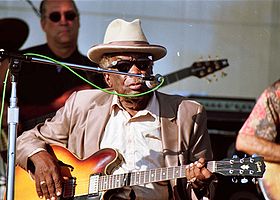
JOHN LEE HOOK


ROBERT CRAY

In the film 'The Jerk' Steve Martin says, "Wanna sing some blues, Son?" "No, Ma, there's something about those songs that sure depresses me." Again this is Hollywood and people from there on thought the Blues was all about somebody leaving, the dog left or die and so on. This is not the Blues original and it even was played as a party music, at one time.
The original blues was a mixture of African and European folk music, gospel, and work song and started in the Southern States of America. To start with Blues musician were busking and travelling from factories to plantations to bars and mostly on pay-days playing whatever was requested and paid.
It is thought that the first recording was 'Memphis Blues' in 1912 by W. C. Handy. He was a black bandleader and copied the style from street musicians when he was touring in the South. From 1920 the Blues' records started selling. When Ma Rainey brought out the 'Cracy Blues' which was a hit many record companies and singers followed. Bessie Smith and Victoria Spivey sold single by the millions. That was Blues cleaned-up and genteel. It differs from the down-to-earth back woods slide-guitar music which was played in bars. That kind of Blues was played mostly by jazz musicians. Up to this point the musicians were all men. When they introduced the so-called 'classic' Blues the performers were all women.
In the '30s the so-called Delta blues started to emerge. The name derived from that most singers lived in the area of the Mississippi. The most famous of the Delta pioneers was Robert Johnson. There was story going round that he sold his soul to the devil to be able to play the guitar. If it was true it worked and was cheaper than paying for lessons. He only recorded 37 songs and died at the age of 26. He was poisoned by a jealous husband. His music lives on and the 'Love in vain' and Ramblin' on my mind' are still played and recorded today.
In the '30s and '40s great numbers of black Americans moved up to the industrial North to work. They also brought their music with them and performed in bigger and noisier places. Nobody could hear them. The electric guitar was invented and with added drums, bass and brass they could be heard above the noise. In Memphis the Blues had a great influence on the early Rock 'n' Roll.
The Blues is mostly associated with Chicaco because of the Chess Recording Studio. There emerged some famous names like, Chuck Perry, Bo Diddley, Willie Dixon and the 'King of the Chicago Blues' Muddy Waters. Songs like 'Mannish Boy' and 'Got my Mojo working' became famous.


MUDDY WATERS

B B KING

In the '80s the cult film 'The Blues Brothers' brought the Blues a revival. B B King made a name in '50s and now still playing to a much younger audience. John Lee Hooker is also still playing and now more known then in his earlier career. Songs like 'The Healer', 'Mr Lucky', 'Boom Boom' and 'Don't Look Back' made him famous.

ERIC CLAPTON
Eric Clapton has returned to his roots with 'From the Cradle' combining the traditional blues guitar of B B King with the soulful voice of Sam Cook. A new-comer Robert Cray made award-winning albums with songs like 'Bad Influence and 'Strong Persuader.' He joined Eric Clapton and Tina Turner on a sell-out tour.
Nowadays, most of the Blues is played in Pub and bars. Small record labels are sold in low numbers which makes the Blues return to its earlier days.

SUMMARY: The Blues is the real music coming right from the heart and soul about their lives and hardship. It was played and sang in the evening for entertainment. After a hard day's work they were dreaming about their homeland and family in Africa