Showing posts with label canada. Show all posts

Tuesday, 20 December 2016

SUICIDAL ABORIGINAL TOWN IN CANADA


The struggling, isolated town of Attawapiskat in Ontario, Canada has an unbelievable high number of suicide's attempts and suicides. 130 people of the 2000 inhabitants have tried in one year.


The town's chief  Bruce Shisheesh explains the reasons are being an isolated community with high unemployment, overcrowded, boredom and loneliness.


Three-quarters of Attawapiskat's population are under 35 and most of the elders speak Cree.


The crisis has pushed the health service to breaking point. The town can only be reached, in winter,  by ice roads. When the temperature rises and the thick ice starts to melt it can only be reached by air. It  closes the supply of drugs and alcohol which slows down the addiction for a time being.


Attawapiskat is 60 miles from the Victor diamond mine owned by the De Beers but the community is incredible poor even by aboriginal standards. The diamond mine does provide only some employment and the people of Attawapiskat survive mostly by hunting and fishing.


By now the Aboriginal leaders lost all their belief in the promises of help from the Canadian Government.  They received promises too often but were never kept and all the time the suicides continued.


Wednesday, 18 April 2012

POWER BOATS


The two categories of boat design are sailing boats and powerboats. The sailing boats look graceful and elegant. However, it is the powerboat that is the winner of the two because most drivers can't wait for the wind to come up.
The drivers love for powerboats does also stem from driving a motorcar. The boats have an internal combustion engine. It started in Germany in 1885 when Gottfried Daimler fixed a petrol engine to a small boat. From there on it has developed and improved more and more. Soon the motorboats were easy to handle. When they began to get faster, they were called speedboats or powerboats.
==========================================================================
IF YOU SEE AN ADVERT WHICH INTERESTS YOU PLEASE CLICK ON IT TO FIND MORE DETAILS
============================================================================
Then the competitions started and with it the compulsory helmet. The powerboat's driver has now an opportunity to prove his design is a winner. The international governing body - the Union Internationale Motoautique (UIM) - established certain rules and regulation.

SPEEDBOAT RACE VANCOUVER

The boats got faster but there was also a development of another sport. In 1922 the teenager from Minnesota, Ralph Samuelson, changed his snow skis, which were made from barrel staves, to be used on the surface of the lake. He is officially acknowledged as the inventor of waterskiing.
There are two types of powerboat race. One is the circuit racing and the other the offshore racing. The races have a wide variety. They range from club contests to the international races in the UIM calendar.
Circuit racing is held on inland or sheltered water and has to have a minimum of depth of 1.2m. The boats are known as sportsboats.  In this class are monohulls and catamarans and the driver have to be seated.
Hydroplanes with two hulls in the front and joined into one at the rear of the boat. The driver can either sit, kneel or lie down.


POWERBOATS OFF-SHORE BRITAIN

Off-shore races, as the name suggest, are held on the open sea. The rules demand to have two members in the crew. One is the driver and the other is the navigator. Sometimes a third one operates the throttle. It is also rule that each crew member has to be linked to the kill-switch cord. The reason for this is that if a crew member is thrown over board it stops the engine. When there is a powerboat racing there are always rescue crafts standing by.
Powerboats are classed by the size of their engine and in off-shore race the length of the boat. The variety of boats is enormous. There are boats with inboard engine and outboard engines. The smaller boats can be powered by petrol. The bigger craft are powered by diesel or gas turbine engine which also makes them faster.
By circuit and short off-shore races the course is marked by buoys. The boats are not allowed to touch them.  At the start of a race a green light comes up and the start flag is dropped. The end of a race is signalled by a chequered or red flag. The boats are timed at each lap.
America's Hudson River Gold Cup and France's River Seine are a 24-hours endurance race but both are known inland events. The off-shore races are long distance. There is the Cowes to Torque which is off the coast of Britain.  Another one is the Venice to Monte Carlo to name just two. The others are transatlantic events.
Surprise, surprise, the powerboat drivers like to break speed records. The famous Blue Riband trophy is for the highest average speed while crossing the Atlantic. In 1992 the 68m Italian powerboat Destrien had an average 53.09 knots in a 58-hours trip.
http://www.awltovhc.com/image-2103840-5902068http://rover.ebay.com/roverimp/1/711-53200-19255-0/1?ff3=10&pub=5574636337&toolid=10001&campid=5335845462&customid=1288299-7522721&uq=Powerboat&mpt=984449443
http://www.awltovhc.com/image-2103840-5902068
Top of Form
Bottom of Form

http://www.awltovhc.com/image-2103840-5902068
Top of Form
Bottom of Form

Sunday, 25 March 2012

CANADA


BANFF  
JASP
Canada is a fascination country. The land stretches from the Arctic in the north to the border of the USA. A great variety of climate and way of life of people. The economy is one of the best. 
Canada has as a simple the maple leaf. The red of the flag is a reminder of the blood shed by Canadian soldiers during World War I. The white is for the snow which covers Canada for up to six months of the year.
LAND
The extreme vegetation of the land, the variety of people and one of the most successful economies can only be found in Canada. The land reaches from dense forest with mighty evergreens to the prairies. It covers the arctic and the subarctic flora in the north. the forests are of spruce, hemlock, pines, firs and cedar trees.
The variety of wildlife you is unbelievable. There are several types of weasel, black and grizzly bears, lynxes, wolves, coyotes, foxes and skunks.
Polar bears are to be found in the arctic regions.
Pumas live in British Columbia and gophers are living in the plains.
Elk and bison are in the west and caribous live in the north.
Bighorn sheep and goats live in the mountains. Canada hasn't got any reptiles, apart from the far south, nor insects but for the mosquitoes.
The National Parks are of 730,000 sq km and are Jasper and Banff. Banff has four million visitors a year.
Only 5% of the land is suitable for farming.
PEOPLE
Canada's population is 40% British, 27% French, 20% European and 1.5% indigenous Indian and Inuit. The Inuit are official recognised as the First Nations. The rest is of any nationality of the world. The two official languages are English and French. The First Nations speaks one of the eleven native languages.
Most of the people live in Toronto, Montreal and Vancouver. French-speaking Canadians live mostly in Quebec.
Canadian people enjoy a high standard of living. Education is free and compulsory from 6 years till 15 or 16 years old Most go onto higher education. Social welfare is established in both states.and paid for by state-sponsored insurance programmes.
Half of the population are Catholics and half of them live in Quebec. The rest are Protestant, Jews, Hindus, Sikhs and others.
Till the late 19th century the cultural influence was French and English. After that a Canadian style developed. The government is now trying to encourage to be a multi-cultural culture. This includes arts from aboriginal people. Famous personalities are writers are Margret Atwood and Robertson Davies and the musician Leonard Cohen to name but a few.
Canadian are known for their winter sport such as curling and ice hockey which win them medals in Winter Olympics.
ECONOMICS
Canada's trade with its neighbour the USA is 80%. It contains the manufactured transport equipment, food, machinery, paper, chemicals and metals. The workforce is of 42% trade and service, 25% of manufacturing and industry, 7% of administration. and 4% of agriculture, forestry, fishing and trapping.
The land is rich in natural resources of zinc, gold, silver, oil, natural gas, cobalt and uranium. As for hydroelectric power it is the world largest provider.
Another great economic factor is their farming and agriculture. They grow 20% of the world's wheat on their prairies. The major farming in the west have 15 million cattle. The farms also grow cereal crops, fruit, tobacco and soya beans. About 14% are forestry products and covers the demand of most of the world's newsprint.
Over a half of a century Canada has been fishing commercially. The north-west Atlantic and north-east Pacific supply cod, herring, salmon, flunder, lobster, scallops, crab and redfish.
The trapping has declined since 1990.

Tuesday, 14 February 2012

CANADA - A WORLD LEADER


The name Canada comes from an Iroquoian word and it means village or community. The Iroquois are a native tribe of North America and controlled the area during the 18th century.

Canada is a massive country. It is the world’s second-largest and has huge natural resources plus it is highly industrialized. The people enjoy a high standard of living and have awe-inspiring scenery.

The size of Canada crosses five time zones. The country stretches from the North Pole and half-way to the equator. The size of it is 1.7 million sq km which includes the Arctic Islands and other coastal island. It is right across North America.


In the north is the Arctic Ocean; Alaska on the north-west side; The Atlantic Ocean on the east; the USA in the south and the Pacific Ocean on the west.
                                                     TUNDRA

Travelling to the north there are the Arctic islands and the tundra. The more you move south Canada become forests with lakes and vast flowing rivers. Even further south the country changes into prairies.
Geographically Canada has five regions, apart from the Arctic. The Canadian Shield is the largest. It is a huge horse-shoe shaped area surrounding the Hudson Bay. The other two regions are in the east and are the Appalachian region and Great Lakes-St Lawrence lowlands. In the west of the Canadian Shield are the Interior Plains and it is the country’s most fertile soil. The last one is the Cordillera where the Rocky Mountains are and the highest is Mount Logan at 5951m. 
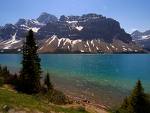
                                                 BANFF - 
  THE ROCKY     MOUNTAINS
Canada has many lakes and rivers. There is Great Bear Lake, Great Slave Lake, and Lake Winnipeg to name just a few. These three great lakes are drained by the St Lawrence River. The other great rivers are the Ottawa and Mackenzie. A very famous sight is the Niagara Falls in Ontario with a height of 50m. It is a great tourist attraction.

Since Canada is such a huge country it also means that the climate varies widely. It stretches from Arctic conditions to milder climate in the south. On a whole the climate is snowy cold winter and hot summers. In the Cordillera is a dry, west wind which moderates winter conditions in the Rockies and it is called Chinook.

Canada is a leading export nation. It supplies to the USA 80% and the USA imports two-thirds to Canada. Canada’s industry consists of manufacturing transport equipment, food, machinery, paper, chemicals and metals. Their workforce is 42% of trade and service; 25% manufacturing and industry; 7% of public administration and 4% of agriculture, forestry, fishing and trapping.

The country has a great wealth of natural resources. They are zinc, gold, silver, oil, natural gas, cobalt and uranium. It is also the world’s largest supply of hydro-electric power.

The tourists are encouraged by the annual Calgary Exhibition and Stampede which is world famous. Furthermore, there are the national parks of Jasper and Banff.  Banff alone has over 4 million visitors a year. 

In spite of Canada has only 5% agricultural land, it is an important export. Canada supplies 20% of the world wheat grown in the prairies. In the west of Canada are the cattle ranches with 15 million cattle. The arable farms growing cereal crops, fruit, and Soya beans. 14% of the exports are forests products. The world’s newspaper comes mostly from Canadian forests.

The commercial fishing which is over half century old and the catch comes from the north-west Atlantic and the north-east Pacific. It is cod, herring, salmon, flounder, lobster, scallops, crab and redfish. 

Fur-trapping was an important export but it declined because of loss of demand.


FEDERAL POLITICS
Canada is a federal union. The power is shared between central and provincial governments. The head of state is the governor-general who represents the British monarch. Canada is a member of the British Commonwealth. Since the 1982 Constitution Act has now complete authority. The Parliament has two chambers. There are a 295- member of House of Commons and a 112- member senate. Members of the House of Commons are elected by the people over 18 years. They stay for a maximum of five years. Senators are chosen by the government and can stay in office till the age of 75.

Canada is divided into 10 provinces and two territories. A third territory was created in 1999 for indigenous Inuit population. Each province is governed by its own premier. The territories are governed by federally appointed commissioners.

FROM THE ICE AGE TO THE PRESENT DAY

Mongoloid people arrived in North America in the Ice Age. They split up, eventually, into various tribes. Just to name but a few were the Cree, the Blackfoot and the Iroquois. The European arrived in 16th century and Jacques Cartier claimed Canada for France in 1534. By 1608 there was a French settlement in Quebec. 

From there on the native people were diminishing. The reasons were European diseases and alcohol abuse. In 1867 Britain won Canada from the French and it became a British Dominion.

At the beginning of the 20th century Canada become one of a top manufacturing and trading nation and because of that won its independence.

Originally, the government was either Liberals or Progressive Conservatives and the New Democrats as a third party. In October 1993, there were two new parties gaining power. One was the Conservative Reform Party and the other the Bloc Quebecois. They want independence for Quebec.